GoFlex Fintech
Wallet Design

GoFlex Fintech
Wallet Design

GoFlex Fintech
Wallet Design

UI/UX Design Case Study

UI/UX Design Case Study

UI/UX Design Case Study

Platform

GoFlex Web App

Platform

GoFlex Web App

My Role

Lead Product Designer

Timeline

4 months

Scope

Wallets · Escrow · Disputes

SETTING THE SCENE

SETTING THE SCENE

This case study explores how I redesigned the post-payment experience by introducing Wallets, Escrow Protection, and an Internal Dispute Resolution System not as “new features”, but as a response to real user pain points and business needs. The result improved trust between merchants and clients, reduced chargeback-related losses, and gave merchants greater control over their earnings.

This case study explores how I redesigned the post-payment experience by introducing Wallets, Escrow Protection, and an Internal Dispute Resolution System not as “new features”, but as a response to real user pain points and business needs. The result improved trust between merchants and clients, reduced chargeback-related losses, and gave merchants greater control over their earnings.

About the product

About the product

About the product

GoFlex is a Fintech Merchant of Record (MoR) platform that helps freelancers, solopreneurs, SME’s and digital nomads receive payments globally without dealing with compliance,or international payout complexities.

GoFlex is a Fintech Merchant of Record (MoR) platform that helps freelancers, solopreneurs, SME’s and digital nomads receive payments globally without dealing with compliance,or international payout complexities.

GoFlex is a Fintech Merchant of Record (MoR) platform that helps freelancers, solopreneurs, SME’s and digital nomads receive payments globally without dealing with compliance,or international payout complexities.

My role

My role

Lead designer of the product from research, ideation and designing of the prototype and testing phase.

Lead designer of the product from research, ideation and designing of the prototype and testing phase.

Timeline

Dec 2025- April 2026

People

1x Product designer

1x PM
1x QA Engineer

2x Front-end developers

2x Back-end developers

SETTING THE SCENE

SETTING THE SCENE

Background

Background

Background

In the first version of the GoFlex web app, payouts were fully automatic. Users (merchants) could send an invoice and once the end-client paid for the invoice, we triggered an automatic payout to the merchant’s local bank account within 3 business days.


The system worked perfectly, payouts was fast but as the user base grew, new problems surfaced: Chargebacks started happening due to fraudulent invoices, merchants had no control over when their payouts were sent, user engagement on the web app reduced significantly, customer support team was overwhelmed with payout-related confusion, and GoFlex had no buffer to detect fraud before money left the platform.


These issues became even more important as more international transactions and higher invoice values started flowing through the system.

In the first version of the GoFlex web app, payouts were fully automatic. Users (merchants) could send an invoice and once the end-client paid for the invoice, we triggered an automatic payout to the merchant’s local bank account within 3 business days.


The system worked perfectly, payouts was fast but as the user base grew, new problems surfaced: Chargebacks started happening due to fraudulent invoices, merchants had no control over when their payouts were sent, user engagement on the web app reduced significantly, customer support team was overwhelmed with payout-related confusion, and GoFlex had no buffer to detect fraud before money left the platform.


These issues became even more important as more international transactions and higher invoice values started flowing through the system.

In the first version of the GoFlex web app, payouts were fully automatic. Users (merchants) could send an invoice and once the end-client paid for the invoice, we triggered an automatic payout to the merchant’s local bank account within 3 business days.


The system worked perfectly, payouts was fast but as the user base grew, new problems surfaced: Chargebacks started happening due to fraudulent invoices, merchants had no control over when their payouts were sent, user engagement on the web app reduced significantly, customer support team was overwhelmed with payout-related confusion, and GoFlex had no buffer to detect fraud before money left the platform.


These issues became even more important as more international transactions and higher invoice values started flowing through the system.

DESIGN PROCESS

DESIGN PROCESS

Discover

Discover

Discover

Define

Define

Define

Ideate

Ideate

Ideate

Design

Design

Design

Testing

Testing

Testing

DEFINING THE USERS

DEFINING THE USERS

GoFlex Merchants

GoFlex Merchants

GoFlex Merchants

End Clients

End Clients

End Clients

GoFlex Internal team

GoFlex Internal team

GoFlex Internal team

🕵️‍♀️ Research & Problem Discovery

🕵️‍♀️ Research & Problem Discovery

We realized there was a problem when...

We realized there was a problem when...

When we rolled out the Beta version of GoFlex, we added a small NPS modal in the web app to collect feedback from users (merchants) and their end clients. Over a period of 4 months, we noticed that the scores were lower than expected. This was our first signal that something in the GoFlex experience was frustrating users and their end clients.


To understand why, we followed up with users who gave low scores (Detractors). We conducted interview calls with:
15 merchants and

7 end clients, asking about their experience using GoFlex


During the same week, the PM mentioned during sprint planning that GoFlex had been experiencing chargebacks from the end clients. This prompted us to set up interviews with the Finance and Operations team to understand the root causes of these charge backs


When we rolled out the Beta version of GoFlex, we added a small NPS modal in the web app to collect feedback from users (merchants) and their end clients. Over a period of 4 months, we noticed that the scores were lower than expected. This was our first signal that something in the GoFlex experience was frustrating users and their end clients.


To understand why, we followed up with users who gave low scores (Detractors). We conducted interview calls with:
15 merchants and

7 end clients, asking about their experience using GoFlex


During the same week, the PM mentioned during sprint planning that GoFlex had been experiencing chargebacks from the end clients. This prompted us to set up interviews with the Finance and Operations team to understand the root causes of these chargebacks

When we rolled out the Beta version of GoFlex, we added a small NPS modal in the web app to collect feedback from users (merchants) and their end clients. Over a period of 4 months, we noticed that the scores were lower than expected. This was our first signal that something in the GoFlex experience was frustrating users and their end clients.


To understand why, we followed up with users who gave low scores (Detractors). We conducted interview calls with:
15 merchants and

7 end clients, asking about their experience using GoFlex


During the same week, the PM mentioned during sprint planning that GoFlex had been experiencing chargebacks from the end clients. This prompted us to set up interviews with the Finance and Operations team to understand the root causes of these charge backs


We’d love your feedback

On a scale of 0–10, how likely are you to recommend GoFlex to a friend or colleague?

1

2

3

4

5

6

7

8

9

10

Not likely

Very likely

Skip form

Submit feedback

INTERVIEWS QUOTES

INTERVIEWS QUOTES

Sandra

Sandra

Merchant

Merchant

“I love how fast payouts come in, but honestly, I wish I had more control over the amount withdrawn. Money just lands in my bank account whether I’m ready or not, and it makes budgeting difficult.”

Rayden

Rayden

Merchant

Merchant

“Once I send an invoice and receive the payout, I don’t really check GoFlex again until I have another one to send. There’s nothing really pulling me back into the product.”

Martins

Martins

End Client

End Client

“I paid for an invoice and the merchant disappeared. At that point, I didn’t even know what my options were inside GoFlex, so I just contacted my bank”

Shelby

Shelby

End Client

End Client

“I wish the system could hold the money until I confirm the work is done. Paying upfront without any control is a bit risky for me sometimes”

Anna

Anna

GoFlex Operations

GoFlex Operations

"Every time an end client files a chargeback with their bank, it becomes a much bigger problem than if they'd just come to us first."

Jude

Jude

GoFlex Finance/compliance team

GoFlex Finance/compliance team

“By the time we’re aware of a dispute or fraud issue, the payout has already gone out. That’s where we start losing money.”

INSIGHTS/PAIN POINTS GATHERED FROM RESEARCH

INSIGHTS/PAIN POINTS GATHERED FROM RESEARCH

📉 Users had no reason to return

📉 Users had no reason to return

Most merchants used GoFlex only to create and send invoices, which explained the low engagement and retention we observed in PostHog.

Most merchants used GoFlex only to create and send invoices, which explained the low engagement and retention we observed in PostHog.

💰 Merchants wanted control over their earnings

💰 Merchants wanted control over their earnings

Users preferred deciding when to withdraw funds instead of having payouts automatically sent to their bank accounts.

Users preferred deciding when to withdraw funds instead of having payouts automatically sent to their bank accounts.

🛡️ End clients wanted payment protection

🛡️ End clients wanted payment protection

Clients were uncomfortable paying for work that hadn't been delivered and wanted a safer way to release funds.

Clients were uncomfortable paying for work that hadn't been delivered and wanted a safer way to release funds.

👀 Payment statuses were unclear

👀 Payment statuses were unclear

Users struggled to understand where their money was in the payout process, leading to frequent support inquiries.

Users struggled to understand where their money was in the payout process, leading to frequent support inquiries.

⚖️ Disputes were happening outside the platform

⚖️ Disputes were happening outside the platform

When issues arose, clients often went directly to their banks, resulting in chargebacks and financial losses for GoFlex.

When issues arose, clients often went directly to their banks, resulting in chargebacks and financial losses for GoFlex.

Chargeback risks

Chargeback risks

GoFlex was experiencing increasing chargebacks from clients who paid invoices but never received the service because a few fraudulent merchants abused the platform.

Since payouts were instant and automatic, GoFlex had no safety net. Money was already gone before issues surfaced

GoFlex was experiencing increasing chargebacks from clients who paid invoices but never received the service because a few fraudulent merchants abused the platform.

Since payouts were instant and automatic, GoFlex had no safety net. Money was already gone before issues surfaced

BUSINESS GOALS IDENTIFIED

BUSINESS GOALS IDENTIFIED

Reduce our exposure to chargebacks and fraudulent payouts

Reduce our exposure to chargebacks and fraudulent payouts

Reduce our exposure to chargebacks and fraudulent payouts

Give merchants more control over payout withdrawal to reduce frustration and churn

Give merchants more control over payout withdrawal to reduce frustration and churn

Improve the GoFlex web app engagement beyond invoicing

Improve the GoFlex web app engagement beyond invoicing

Establish a more predictable internal financial workflow

Establish a more predictable internal financial workflow

Strengthen trust with clients and real merchants

Strengthen trust with clients and real merchants

Protect end-clients from fraudulent merchants

Protect end-clients from fraudulent merchants

Protect end-clients from paying for invoices before deliverables are completed

Protect end-clients from paying for invoices before deliverables are completed

DEFINING THE CHALLENGE

DEFINING THE CHALLENGE

Framing problems as opportunity with HMW

Framing problems as opportunity with HMW

Framing problems as opportunity with HMW

By this point, the problem was becoming clearer: Merchants wanted more control over their earnings. End clients wanted protection against paying for incomplete work. Finance and Compliance needed time to review transactions before funds were released. and the business needed a way to reduce losses from chargebacks.


To guide our thinking, we framed a series of How Might We questions:

By this point, the problem was becoming clearer: Merchants wanted more control over their earnings. End clients wanted protection against paying for incomplete work. Finance and Compliance needed time to review transactions before funds were released. and the business needed a way to reduce losses from chargebacks.


To guide our thinking, we framed a series of How Might We questions:

💡 Exploring Possible Solutions

💡 Exploring Possible Solutions

Exploring different directions

Exploring different directions

Before committing to a solution, we explored multiple system approaches that could address our core problems. Each had potential, but also significant tradeoffs.

Before committing to a solution, we explored multiple system approaches that could address our core problems. Each had potential, but also significant tradeoffs.

1

Improve Communication & Visibility

Keep the existing flow for payment and transactions as is but improve visibility through better timelines, notifications, and transparency

Why we considered it

Doesn't require overhaul of the current designs

Better visibility could improve trust and reduce merchant issues

Better visibility could improve trust and reduce merchant issues

Quick to implement

Less engineering effort

Improvement of the current system

Tradeoffs

Doesn't solve fraud or chargebacks

Doesn't solve fraud or chargebacks

Doesn't protect clients from payment-not-delivered

Doesn't protect clients from payment-not-delivered

Doesn't address low engagement or retention

2

Hold a Percentage of Every Payment

Release most of the payment to merchants immediately but hold some percentage as a safety buffer

Why we considered it

Offers a balance between protecting clients and paying merchants

Allows merchants access to most of their money

Provides some protection against fraud

Creates incentive for merchants as a safety fund

Tradeoffs

Clients are still exposed to risk

Merchants must wait for some portion of their earnings

Creates confusion around payout timing

Doesn't solve dispute resolution

3

Manual Transaction Review Before Fund Release

Every invoice payment would enter a pending state and require a member of the finance team to manually review and approve the transaction before funds became available to the merchant.

Why we considered it

Would significantly reduce fraudulent payouts.

Gives Operations full visibility into every transaction.

Minimizes chargeback losses

Tradeoffs

Doesn't scale with growing transaction volume

Creates operational bottlenecks and slower fund release.

Creates operational bottlenecks and slower fund release.

Delays access to funds for legitimate merchants

4

Delayed Payout System

Holds all payments for a fixed period before releasing funds to merchants

Holds all payments for a fixed period before releasing funds to merchants

Why we considered it

Increases safety and gives time for issues to surface

Tradeoffs

Frustrates merchants who rely on fast cash flow

Risk of churn due to slower payouts

Risk of churn due to slower payouts

If issues aren’t detected in time, funds still get released

Key Insight

No single solution solved all the HMWs without introducing new tradeoffs. This led us to combine the strongest parts of each approach into a unified trust system:

Wallets

Escrows

Balance States

Dispute Resolution

The Solution

The Solution

The Solution

1

Solution One

Introducing the GoFlex Wallet

Introducing the GoFlex Wallet

Problem

Problem

One of the strongest themes from merchant interviews was the desire for payout control. Users wanted a place to hold their earnings instead of automatically receiving every payment in their bank account.

One of the strongest themes from merchant interviews was the desire for payout control. Users wanted a place to hold their earnings instead of automatically receiving every payment in their bank account.

Solution

Solution

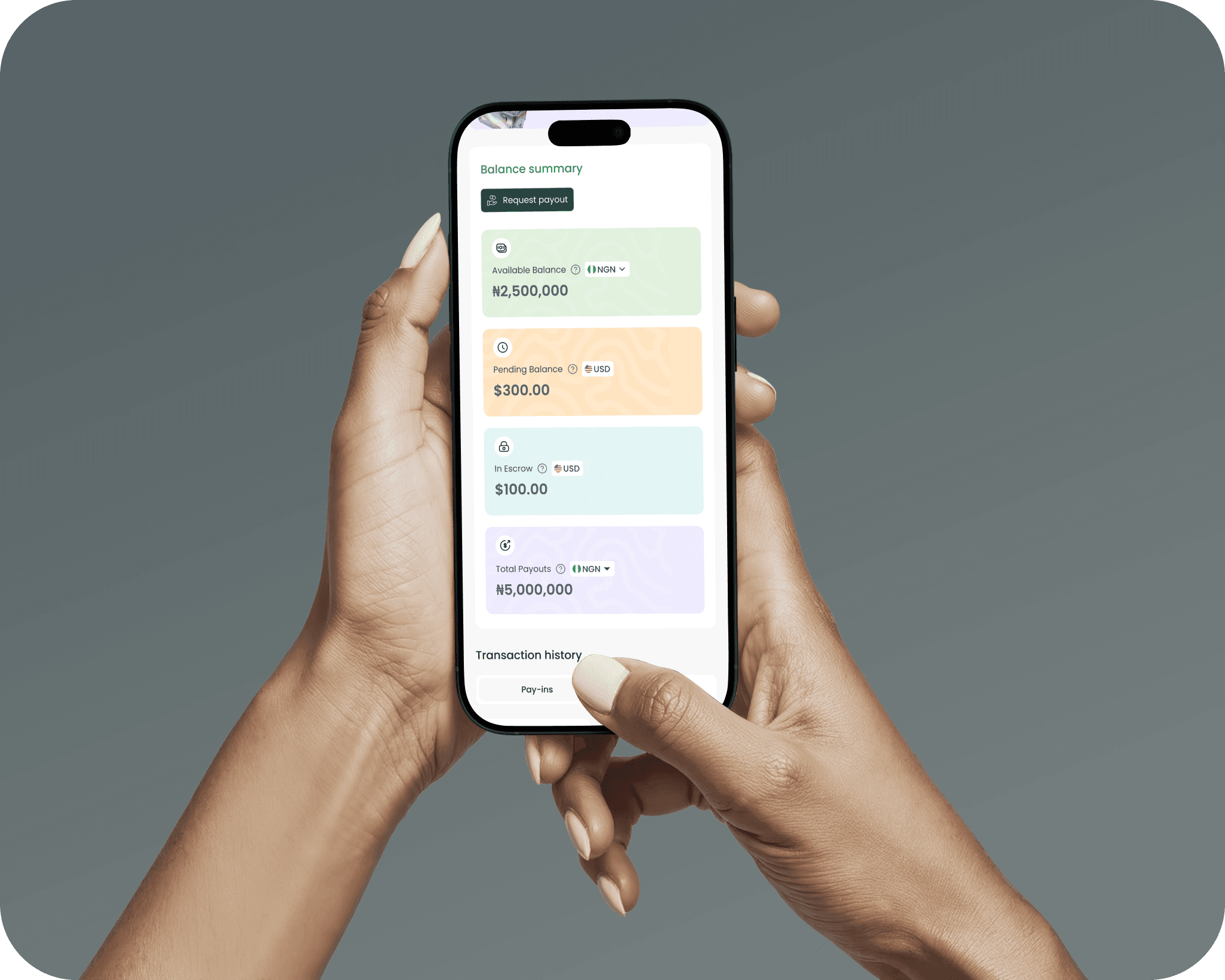
To address this, I designed the GoFlex Wallet system, where every invoice payment first goes into a Pending balance for internal automated review, then the Approved funds move to the Available balance.


With this design, merchants could now:

  1. View their earnings

  2. Monitor payment movement

  3. Withdraw funds on demand

  4. Manage their balance in one place with tool-tips for added clarity


Beyond solving payout control, the wallet also created a stronger reason for users to return to GoFlex after sending invoices, thereby increasing retention and usage.

To address this, I designed the GoFlex Wallet system, where every invoice payment first goes into a Pending balance for internal automated review, then the Approved funds move to the Available balance.


With this design, merchants could now:

  1. View their earnings

  2. Monitor payment movement

  3. Withdraw funds on demand

  4. Manage their balance in one place with tool-tips for added clarity


Beyond solving payout control, the wallet also created a stronger reason for users to return to GoFlex after sending invoices, thereby increasing retention and usage.

Users can now withdraw their earnings anytime they want to thier
local bank account by requesting a payout

Users can now withdraw their earnings anytime they want to thier local bank account by requesting a payout

Request a payout

Request a payout

Transfer funds from your wallet to your designated local account

Transfer funds from your wallet to your designated local account

Cancel

Cancel

Next

Next

2

Solution Two

Making Money Movement Transparent

Making Money Movement Transparent

Problem

Problem

In the previous transaction screen, Pay-ins and payouts were displayed together with their statuses in one table which made it a bit harder for merchants to track their money.

Users didn’t fully understand what was happening with their funds, which created anxiety and reduced confidence in the platform.

In the previous transaction screen, Pay-ins and payouts were displayed together with their statuses in one table which made it a bit harder for merchants to track their money.

Users didn’t fully understand what was happening with their funds, which created anxiety and reduced confidence in the platform.

Solution

Solution

To remove confusion, the transaction history section was redesigned such that Pay-ins and payouts are now separated. Each tab now displays only context, filters and statuses specific to that action. Also, separate wallet balances was introduced
This change improved user comprehension.

To remove confusion, the transaction history section was redesigned such that Pay-ins and payouts are now separated. Each tab now displays only context, filters and statuses specific to that action. Also, separate wallet balances was introduced
This change improved user comprehension.

3

Solution THREE

Protecting clients before funds are released

Protecting clients before funds are released

Problem

Problem

A major source of disputes and chargeback related losses came from clients paying invoices before work had been delivered by their merchants.

A major source of disputes and chargeback related losses came from clients paying invoices before work had been delivered by their merchants.

Solution

Solution

To reduce this risk, we introduced an escrow option during checkout. Clients can choose to hold funds in escrow until deliverables are reviewed and approved. Once the merchant submits the completed work, the client can either release the funds or raise a dispute.

To reduce this risk, we introduced an escrow option during checkout. Clients can choose to hold funds in escrow until deliverables are reviewed and approved. Once the merchant submits the completed work, the client can either release the funds or raise a dispute.

4

Solution four

Giving Finance Time to Catch Risk Before Payout

Giving Finance Time to Catch Risk Before Payout

Problem

Problem

Once a client paid for an invoice, funds were automatically processed for payout to the merchant. This gave the Finance and Compliance team little time to review suspicious transactions before merchants could access their money, increasing the risk of fraud and costly chargebacks.

Once a client paid for an invoice, funds were automatically processed for payout to the merchant. This gave the Finance and Compliance team little time to review suspicious transactions before merchants could access their money, increasing the risk of fraud and costly chargebacks.

Solution

Solution

To create a safer path from payment to payout, I introduced a risk-based review process where funds are temporarily held in the merchant's Pending Balance before becoming available for withdrawal. During this review window, high-risk transactions are automatically flagged for manual review, giving the Finance and Compliance team time to investigate suspicious activity without delaying legitimate payouts.

To create a safer path from payment to payout, I introduced a risk-based review process where funds are temporarily held in the merchant's Pending Balance before becoming available for withdrawal. During this review window, high-risk transactions are automatically flagged for manual review, giving the Finance and Compliance team time to investigate suspicious activity without delaying legitimate payouts.

I also designed an internal review dashboard that enables the Finance and Compliance team to:

1. View payment details, risk levels, review timelines, and dispute windows from a single screen.

  1. Prioritise high-risk transactions for manual investigation.

  2. Request additional information (RFI) from merchants when more evidence is needed.

  3. Pause fund release while a transaction is under review or being investigated.

  4. Approve transactions, automatically moving funds from the merchant's Pending Balance to their Available Balance.

5

Solution FIVE

Resolving Disputes Before They Reach the Bank

Resolving Disputes Before They Reach the Bank

Problem

When clients were unhappy with a transaction, they often bypassed GoFlex and filed chargebacks through their banks. By then, the merchant had usually been paid, leaving GoFlex to absorb the financial loss.

When clients were unhappy with a transaction, they often bypassed GoFlex and filed chargebacks through their banks. By then, the merchant had usually been paid, leaving GoFlex to absorb the financial loss.

Solution

Solution

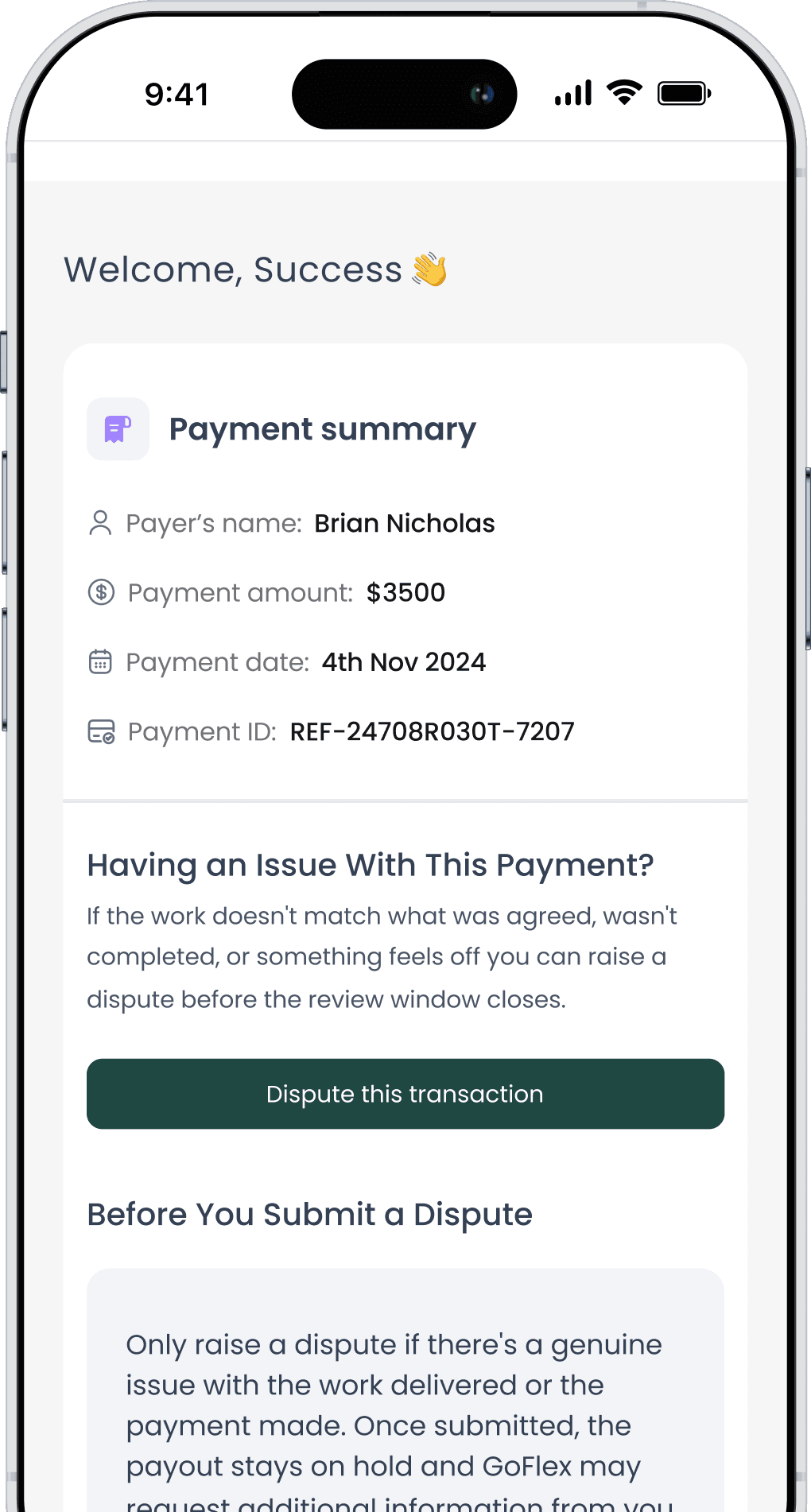
We introduced an internal dispute resolution flow where clients can raise disputes directly in GoFlex. Merchants can respond with evidence, while the Finance and Compliance team reviews both sides before making a final decision, helping resolve issues before they escalate into costly chargebacks.

We introduced an internal dispute resolution flow where clients can raise disputes directly in GoFlex. Merchants can respond with evidence, while the Finance and Compliance team reviews both sides before making a final decision, helping resolve issues before they escalate into costly chargebacks.

1

Clients raise disputes about their invoice payment and submit evidence within GoFlex

Clients raise disputes about their invoice payment and submit evidence within GoFlex

Clients raise disputes about their invoice payment and submit evidence within GoFlex

Merchants can view disputes filed by their end client and can either accept or contest the claim

Merchants can view disputes filed by their end client and can either accept or contest the claim

1

2

The Finance and Compliance team reviews both sides before making a final decision which can either be in favour of the client or merchant

The Finance and Compliance team reviews both sides before making a final decision which can either be in favour of the client or merchant

1

1

2

2

Accessibility

Optimized for

All devices

Optimized for

All devices

Optimized for

All devices

💡HOW AI SPEED-UP THE PROCESS

💡HOW AI SPEED-UP THE PROCESS

AI-assisted workflow

AI-assisted workflow

I incorporated some AI tools into my work process during the designing of these features.
I used AI tools to speed up repetitive parts of my design process and free up time for creative thinking

I incorporated some AI tools into my work process during the designing of these features.
I used AI tools to speed up repetitive parts of my design process and free up time for creative thinking

AI accelerated my workflow, but not my decision-making. Every design decision was grounded in user research, stakeholder feedback, business goals, and my own product thinking. AI simply gave me more time to focus on solving the right problems.

AI accelerated my workflow, but not my decision-making. Every design decision was grounded in user research, stakeholder feedback, business goals, and my own product thinking. AI simply gave me more time to focus on solving the right problems.

Claude

I used Claude to review the dispute resolution flow, which helped me identify an edge case I hadn't considered; a client requesting a partial refund instead of disputing the full payment. I then updated the flow to account for this scenario before development.

ChatGPT

I used Chat GPT for UX copy writing for the empty states, modals, onboarding, and other interface content, which I refined to match GoFlex's tone of voice.

Figma AI & Google Stitch

I used Figma Make & Stitch to quickly generate multiple design directions and UI explorations, which helped me to evaluate different approaches before refining the final experience.

I used Figma Make & Stitch to quickly generate multiple design directions and UI explorations, which helped me to evaluate different approaches before refining the final experience.

Magnific AI

I used Magnific AI to generate and upscale unique, consistent 3D illustrations that aligned with GoFlex's visual language, reducing the time I spent sourcing design assets.

I used Magnific AI to generate and upscale unique, consistent 3D illustrations that aligned with GoFlex's visual language, reducing the time I spent sourcing design assets.

VALIDATED IMPACT

VALIDATED IMPACT

Measurable outcomes

across both launches

Measurable outcomes

across both launches

Phase 1

Wallets & Escrow · December 2025

Reduced support tickets

Reduced support tickets

50%

50%

50% reduction in payment-related support tickets

50% reduction in payment-related support tickets

Escrow feature adoption

Escrow feature adoption

85%

85%

85% of the end clients adopted escrow protection during invoice payment

85% of the end clients adopted escrow protection during invoice payment

Engagement rate

Engagement rate

30%

30%

30% Increment in engagment rate due to users repeated engagement with wallet usage

30% Increment in engagment rate due to users repeated engagement with wallet usage

Phase 2

Internal Disputes · April 2026

Dispute feature adoption

Dispute feature adoption

90%

90%

90% of disputes resolved entirely within GoFlex

90% of disputes resolved entirely within GoFlex

Resolution timeline

Resolution timeline

<3days

<3days

Average dispute resolution time reduced from 5–7 days to under 3 days

Average dispute resolution time reduced from 5–7 days to under 3 days

Chargeback losses

Chargeback losses

50%

50%

50% reduction in chargeback exposure since feature launch

50% reduction in chargeback exposure since feature launch

NEXT STEPS

NEXT STEPS

What I'd improve next

What I'd improve next

These improvements could further reduce friction while strengthening trust across the entire payment journey.

These improvements could further reduce friction while strengthening trust across the entire payment journey.

Milestone-based escrow releases

Break payments into stages tied to deliverable milestones, giving clients granular release control.

Merchant trust scores

Reputation scoring based on dispute history and delivery track record to surface quality merchants.

✨ Key Learnings & Takeaways

✨ Key Learnings & Takeaways

  1. The first solution users ask for isn't always the right one.
    Merchants asked for a wallet, but the real opportunity was redesigning the entire post-payment experience.

  1. The first solution users ask for isn't always the right one.
    Merchants asked for a wallet, but the real opportunity was redesigning the entire post-payment experience.

  1. The best product decisions came from connecting different sources of evidence.
    It wasn't the NPS survey, PostHog, or support tickets alone that revealed the problem, it was seeing the same pattern repeated across all three.

  1. The best product decisions came from connecting different sources of evidence.
    It wasn't the NPS survey, PostHog, or support tickets alone that revealed the problem, it was seeing the same pattern repeated across all three.

  1. This project changed how I think about payment systems.
    I stopped thinking in terms of individual features and started designing around the entire money life cycle: from invoice payment to payout, disputes, and operational review.

  1. This project changed how I think about payment systems.
    I stopped thinking in terms of individual features and started designing around the entire money life cycle: from invoice payment to payout, disputes, and operational review.

Where things are now!

Where things are now!

All features have been developed and are currently live at Trygoflex.com. Today, merchants have greater control over their earnings, clients have a safer way to pay for unfinished work, and the Finance and Compliance team has the tools to review high-risk transactions before payouts are released. Early results have shown stronger merchant engagement, improved retention, fewer payment-related support tickets, and a reduction in chargeback-related losses.

All features have been developed and are currently live at Trygoflex.com. Today, merchants have greater control over their earnings, clients have a safer way to pay for unfinished work, and the Finance and Compliance team has the tools to review high-risk transactions before payouts are released. Early results have shown stronger merchant engagement, improved retention, fewer payment-related support tickets, and a reduction in chargeback-related losses.

Thanks for reading up to this point.

Thanks for reading up to this point.

Thanks for reading up to this point.

GoFlex · Post-Payment Redesign

GoFlex · Post-Payment Redesign

Lead Product Designer · Dec 2025 – April 2026

Lead Product Designer · Dec 2025 – April 2026

Wallets

Escrow

Disputes

Trust Systems

Fintech

Wallets

Trust Systems

Escrow

Fintech

Disputes

Create a free website with Framer, the website builder loved by startups, designers and agencies.